Ink Honey Blossom is a luminous dystopian story that casts lurid light on a real-life human crisis. Also, Liza Losada wants to take you out to lunch.
According to Wikipedia, Sonagachi is one of the largest red-light district in Asia and the world. The etymology of the name is “Tree of Gold.” I did not know this before reading the notes at the end of Ink Honey Blossom. Maybe you didn’t, either. But Liza Losada did, and she built an alternate world around that metaphorical tree.
In this dystopian novel, girls are kept in a house built around the Sonagachi tree. They provide the life force needed by men plagued with the Blight, a deforming and fatal illness. The tree provides a compound by which Blights and girls enter a SonaScape, a dreaming mind meld, with the girls providing the psychic bridge to help Blights get there and back. At the end of a SonaScape the Blights are rejuvenated and regain months of life. The girls lose vitality in equal measure. And thus, Losada weaves a story around a horrifying metaphor to raise awareness about the trafficking of children without writing a single sex scene.

This novel was an incredible ride. In its main character, Ink, the combination of mania, innocence, ruthlessness, and cunning pulled me completely out of my reality and opened me to the very different foundations (or lack thereof) that form her and her peers. Action and dialogue keep the story fresh, even while maintaining the suffocating feeling of an almost wholly unchanging setting that is built to confine the characters. And Losada’s rich vocabulary is never heavy—there’s electricity in every sentence.
Liza, a fellow Sibyl,* is also a healthcare professional, a nurse psychotherapist and psychedelic psychotherapist specializing in trauma and working in research that explores the responsible use of psychedelic drugs for the treatment of mental illness. I corresponded with her recently for some insight into aspects of Ink Honey Blossom that set my mind on fire.
But does she really want to take you out to lunch? Read on to find out.
Donna: For an intro, I’d like to restate what I observed while reading Ink Honey Blossom. As a person with autoimmune issues, I immediately perceived the relationship between Ink and the Blights as a metaphor for autoimmune disease. She is so unwell, and is taken over by something that controls her body and might trap her forever in helplessness akin to a living death. Can you relate for me again how this might be related to your healthcare experience?
Liza: Ink Honey Blossom was written during the Covid pandemic. Issues of health and the long-term effects of the illness were on my mind quite a bit. I am trained to think about how illness impacts every aspect of a person’s life and take special care with the management of those with chronic or lifelong conditions. The House Girls are essentially in a chronic state of failing health. They are languishing from an invisible malady that causes chronic fatigue and physical wasting. Much like many immune disorders where the body attacks its own energy reserves, these Girls are being attacked from the inside. The thing that is slowly killing them comes from them and is directly linked to the exchange of their vitality in service of the health of a foreign body, the Blight’s body.
Much like many immune disorders where the body attacks its own energy reserves, these Girls are being attacked from the inside.
–Liza Losada
Among the symptoms of post-traumatic stress disorder is being unable to trust in one’s own ability to remain safe. Once a trauma occurs, the mind feels that everything is a threat. This puts people in a chronic, sometimes debilitating, state of stress. It becomes very difficult to tell friend from foe. Once again, the autoimmune metaphor returns: the body’s immune system, meant to protect life, is unable to recognize its own healthy system, goes on the attack, and becomes the agent of harm.
In the world of the novel, the Girls are confined for the rest of their lives, trapped inside a House and a societal system that has made their health a commodity. The system is designed to consume them. Some of my patients with autoimmune diseases have shared that their world feels like it has become very small because their experiences, once unrestricted and under their own control, are now dictated by the demands of their illness, unpredictable flares, or overall failing health.
Donna: Okay, now the Sonagachi tree. How did it work its way into Ink Honey Blossom?
Liza: The name of the Sonagachi tree came from the red light district in Kolkata, one of the largest and oldest in the world. But the story is not set in a dystopian version of India—I kept the geography intentionally vague for two reasons. First, I did not want to equate a culture with its societal struggles. This story could take place on any continent; sex-trafficking is a global problem. Second, in Bengali, Sonagachi means “tree of gold.” I liked the idea of naming something that is a slow murderer of little girls after something vibrant and beautiful.
The tree was also a useful device in the physical setting of the story, which takes place inside a square courtyard. I grew up in places that had buildings similar in architecture to the Nectar House. I fashioned it from a mix of the indoor gardens of Moroccan riad houses and my high school in the Caribbean, which was more of an open Spanish patio style. These structures are often associated with relaxation, oases, protection from the outside world. I liked juxtaposing this with life inside the walls of Nectar House, which is anything but relaxed or safe.
Donna: Any specifics you’d like to share about your creative influences (authors, artists who inspire or interest you) and your creative practices, especially the miniature worlds you create with your dioramas?
Liza: These are my absolute favorite questions to answer!
I tore through the Victorians as a teenager and many of the world literature classics, but there is a funny reason for that. I moved to Puerto Rico when I was twelve. Back then, the bookstores almost exclusively sold books in Spanish. Spanish is my first language, but English was my preferred language for reading. Bookstores only carried historical novels and world literature that catered to college-level English reading lists, so I read Austen, Tennyson, Keats, Cummings, Orwell, Kafka, Dostoyevsky, I even slogged my way through Trollope. The Brontes had a tremendous influence on me, the female protagonists in particular. There are Easter eggs that reference Jane Eyre in Ink Honey Blossom. No one has found them yet, but when they do, I’ll treat them to lunch!
There are Easter eggs that reference Jane Eyre in Ink Honey Blossom. No one has found them yet, but when they do, I’ll treat them to lunch!
–Liza Losada
And I have so many influences. Jeanette Winterson inspires me for the beautiful and laconic way she uses language. She can capture a chapter in a sentence. I love Atwood, Lauren Groff, Mona Awad; Rene Denfeld for the deep compassion seeded inside her prose; Allende, Maria Headly, Karen Russell. I am sure I am missing someone important and will feel horribly guilty later. As for artists, I am a pre-Raphaelite through and through, especially paintings that depict poems. The painting and poem The Lady of Shallot were never very far away as I wrote Ink Honey Blossom. As for music, I love Florence and the Machine. I’ve seen her eighteen times in concert and if I am in the middle of a novel when she happens to be on tour, my writing improves.

Sometimes, as I am creating a diorama, I am working through something, like a therapeutic model for a character’s bedroom when the character won’t tell me what she wants next. Working on miniatures puts me in a flow state. This way my brain gets primed to create something with words.
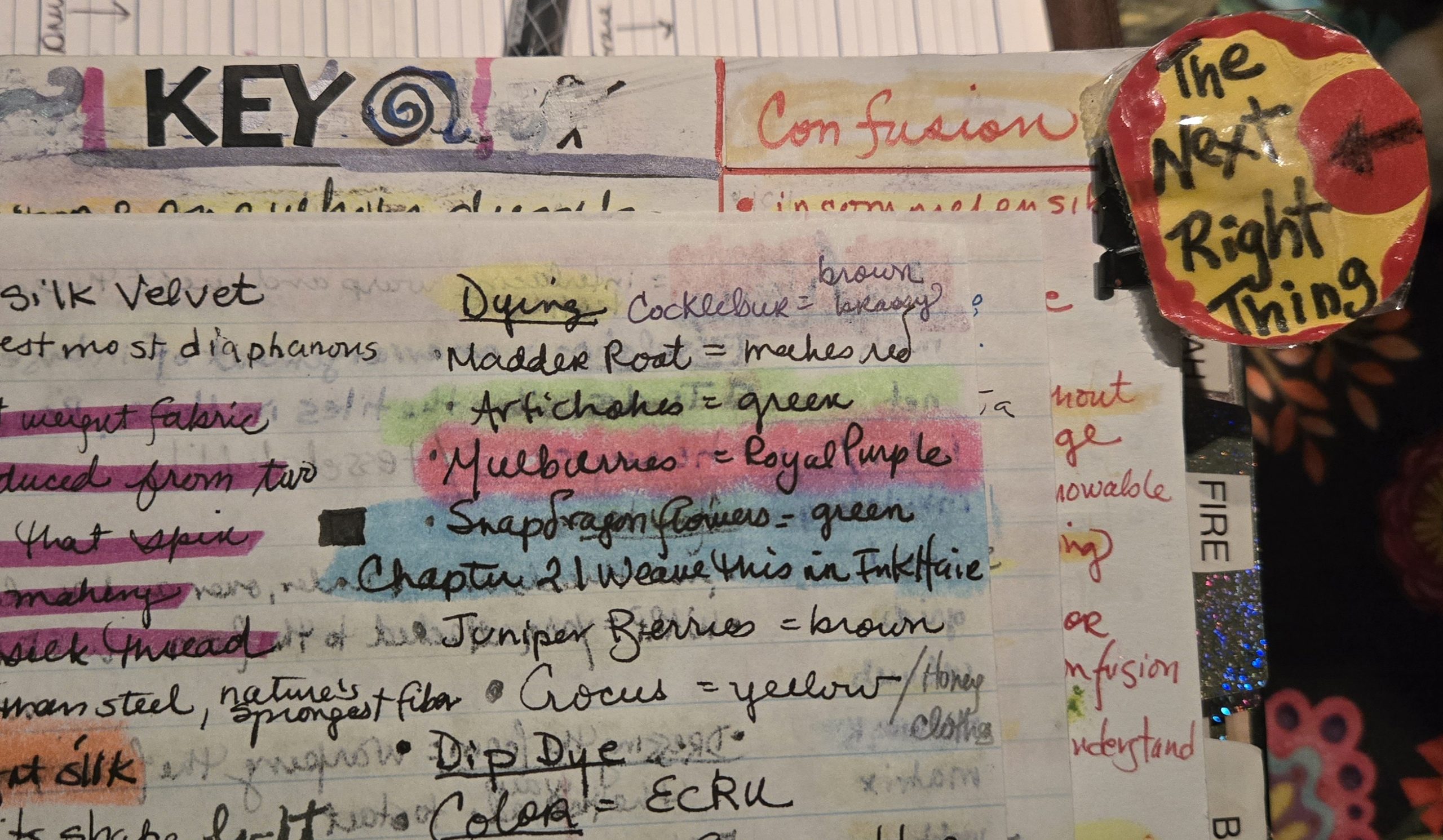
I have a fairly disciplined writing practice in that I set a schedule for the week and commit to those hours like a job. It started when my son was a toddler and I would only get two hours a day while he was in daycare. I never focus on word count, but I do set very specific goals for the writing session, like editing chapter 13 or figuring out how to make the reader nervous in an action scene. It can also be purely seat-of-the-pants writing but I generally know where I hope to land. I do most my initial writing long hand and transcribing it becomes a form of editing in itself. I outline, but very broadly, mostly in the form of scenes or beats. I also outline or map out character arcs. This I have found very helpful to track how the plot, revelations, and twists impact the characters. One thing that helps with a long project like a novel is having one centralized, highly visual reference book.
One thing that helps with a long project like a novel is having one centralized, highly visual reference book.
–Liza Losada
I fill it with images and quotes and costume inspiration as well as having a dedicated section for each character or main idea, that way when I think of something I want to use later or need to find something, like exactly how old Ink was when she was captured, or have I already used that pithy line I came up with while listening to Tom Waits? It’s all there.

One of the tricks that helps me the most is to set up what I am going to work on the next day. I always have something to go back to and a place to start. I even have a paper clip with a little note that reads, “The Next Right Thing.” Eventually, the list of next right things gets smaller and smaller until I have a book, or an intervention by my family and friends who wonder where I have been for months, whichever comes first!
Donna: And finally, What determined the personas you gave to each girl? Why Ink, Honey, Blossom, Bird?
Liza: So much of my process is unconscious. I feel the characters tell me what they want and get cranky when I don’t capture them (no pun intended) in the right way. They liked the names I gave them! My research and the firsthand accounts people have shared with me, often talking about the dehumanizing aspect of their trauma, how they are stripped of identity, suggested the names. One of the best ways to make a person feel powerless and invisible is to take away the signifiers that define who they are. The girls at The Nectar House are not allowed to tell others their real names, or talk about their family or culture. I named the girls after the roles they had at Nectar House as an example of how a dehumanizing system treats people like commodities.

I chose the title with a lot of care. I wanted the girls’ names in the title to honor them, but I wanted the last word in the title to also be a verb. Blossom, the flower and the girl, and “to blossom” to inject that little bit of hope and agency. Also, I count syllables to try for a certain rhythm and prosody, so I liked the way it sounded when I said their names aloud.
Whether or not you find that Jane Eyre reference and want to claim that lunch, find Liza at her website or on Instagram.
*Sibyl, in this context, refers to an author published by Sibylline Press, which publishes Ink Honey Blossom. The Press will publish my memoir, Pain Country, next year.
You must be logged in to post a comment.