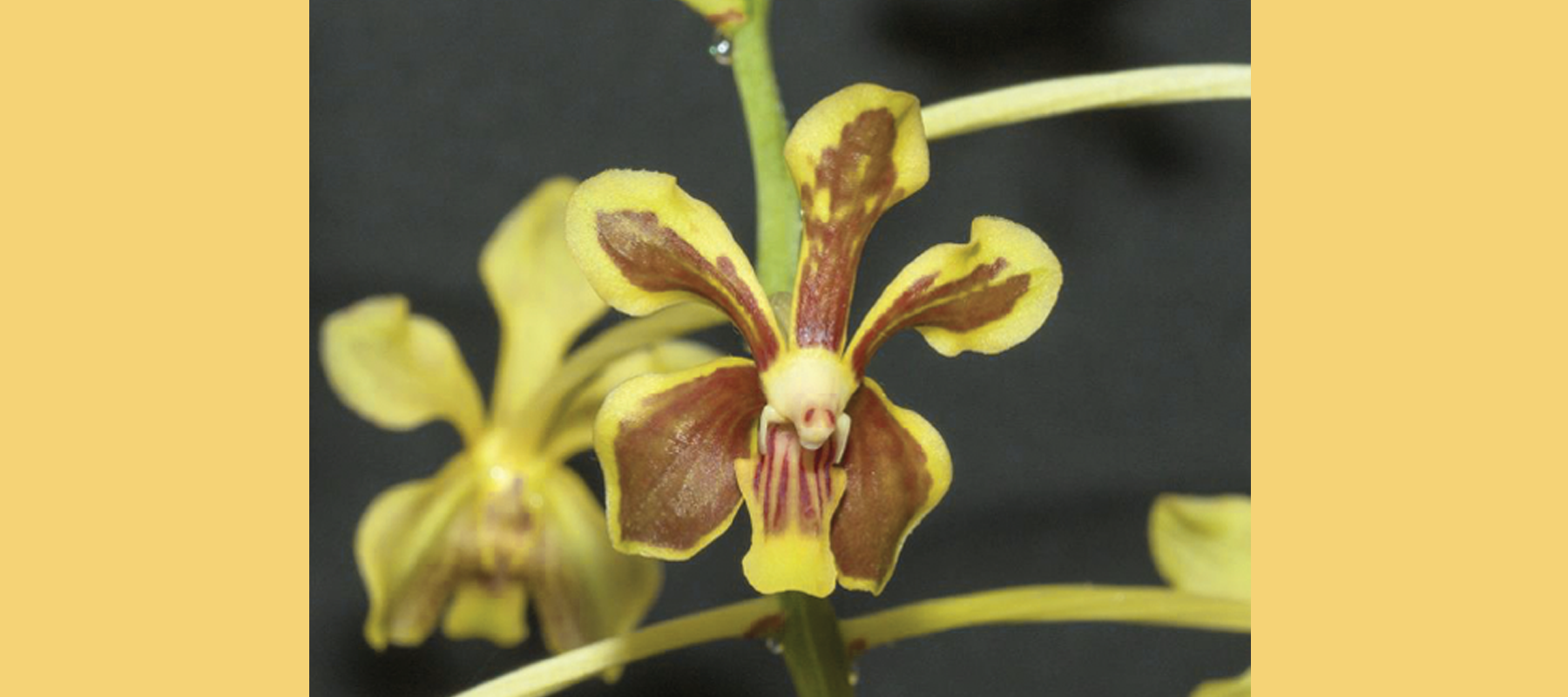
So, I went to the local AOS orchid judging in December 2025 and won an award.
Backstory: I’ve been growing orchids for the last few years; when I got sick they were one of my lifelines. And I started going to Ramapo Orchid Society meetings as part of that. As I got better, I decided to heed ROS urgings to get more involved, go deeper into my orchid education, learn to clerk for judges at shows, and consider getting on a judging track myself–which would take years, but hell, I’m an aspiring novelist, undaunted by time, right? And to test the waters, I attended a local monthly AOS judging event.
My intent was only to observe. What evaluative tools, digital and otherwise, do judges use; how do award seekers determine what plants to submit; what does the scoring process involve for the individual and for the judging group before they vote? My Vanda lamellata happened to be in bloom. In the three years or so I’d been watching Orchid YouTube, visiting various gardens, and attending orchid shows, I’d not seen its like elsewhere. I thought it would be interesting, therefore, to get a score for it.
Vanda lamellata, along with many Vanda varieties, is native to the Philippines and other Pacific island regions in similar latitudes. My Filipina grandmother grew orchids–not the lamellata, but the Philippinesʻ “Waling-waling,” known in Western circles as “Sanderiana” after Frederick Conrad Sanders, one of the first to successfully take it out of the Philippines. Ever attentive to how Filipinas survive and thrive in climates worldwide, I’d attempted one Vanda from an unnamed “bag baby” I purchased at Kona Airport, Hawaiʻi. It struggled and eventually withered in my untutored New York hands, to my sorrow (and even deeper despair for the metaphorical implications). When I stumbled across the lamellata I would buy at Little Brook Orchids in Lancaster, Pennsylvania, in 2023, I was amazed to find it thriving and blooming in an early-spring, not-so-bright, not-so-humid Mid-Atlantic greenhouse. It gave me hope that maybe–maybe!–exotic tropical orchids, living links to my heritage, could grace my home. And my lovely Vanda lamellata has continued to thrive, reliably blooming despite my amateur fumblings with its proper cultivation. (Maybe I’ll go into that more deeply one day.)
As judging got underway, the judges fired up their laptops and settled into a semicircle in a darkened room. AOS-sanctioned specimen images, spreadsheets, and online encyclopedias popped up on their screens. The plants submitted for judging stood on a table outside the semicircle, doing their unmatchable orchid thing: they curved and arched and slow-danced upward, they bloomed with calm extravagance, vibing serenity and grace, Eden-fragrant. Even in the dimmed lights they glowed.
The judges took each plant in turn. They measured and counted the blooms. They studied the information each owner had submitted. When my Vanda lamellata arose for group consideration an image of prototypical comparable blooms, along with the prototype’s identifying data, appeared on a screen dropped down from the ceiling.
One of the judges asked, “Whose is the Vanda?”
Oh, I realized, it’s me.
They asked whether I was sure of the identifying name, “Vanda lamellata, sibling cross,” that I’d submitted. Yes, that was on the tag given me at the nursery. They thanked me for the name of the nursery, murmured asides about the owner’s good reputation. They commented on how my blooms don’t look like any of the recently judged lamellata blooms, which all seemed to be of a different variety. Mine were flatter, more deeply colored. But there were not many blooms on my plant; some buds had shriveled without opening. In the silence, I made an excuse about my tap water. No one smiled. I had not felt terribly attached to this process when I first walked in–I only came to observe!–and so I resented finding that I actually cared about the outcome. I made an unspoken oath to harvest and melt barrels of this year’s abundant snowfall and never again let that accursed tap water touch my plants.
To my shock and delight, the judges awarded my modest-blooming plant a Highly Commended Certificate (AOS-HCC). The prototype they found was presented for judging long ago, in the 1990s. They deemed the blooms on my plant more ideal, agreeing on an overall score of 79. I’m not well versed enough in AOS scoring, nor clairvoyant enough, to speculate on whether better water quality might have earned a higher score for this plant. But as the process of officially recording the award unfolded I learned one all-important thing.
I would get to name her.
The American Orchid Society requires a unique name for plants awarded an HCC, to be recorded and preserved right alongside Frederick Conrad Sanders’s first trophy Vanda specimen.
I thought about it for a moment, my mind blanked by surprise and possibility, but it only took that moment for her name to come to me very clearly. She is Leona, after my grandmother.